Ai2 / OlmoEarth
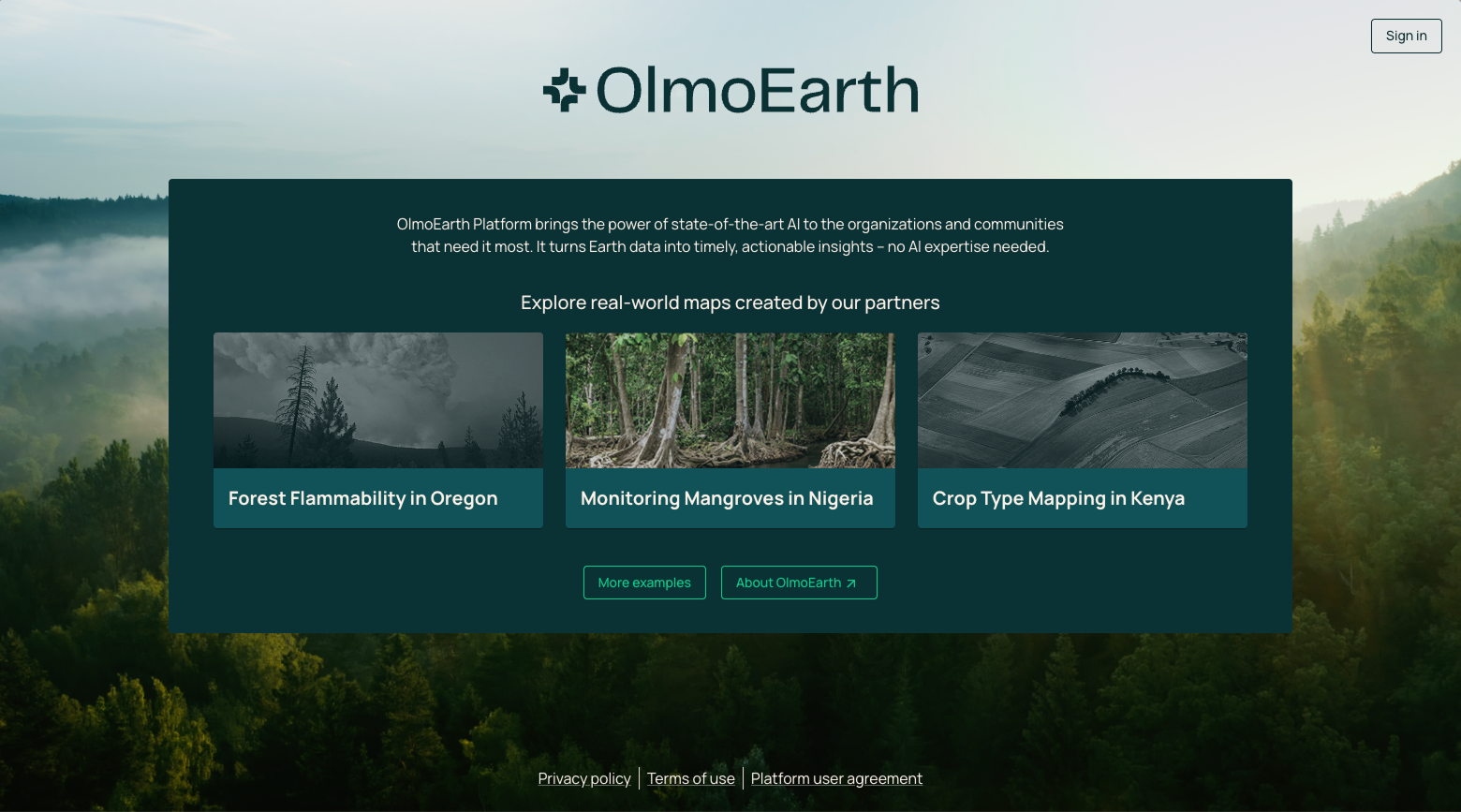
OlmoEarth
Designing a 0→1 Earth intelligence platform for two very different audiences
Overview
In early 2025, AI2's Earth System team needed a platform UI from scratch. OlmoEarth would let researchers monitor, analyze, and understand satellite data – but it had to serve two fundamentally different user groups at once: highly technical AI researchers and ML practitioners on one side, and non-technical subject matter experts (conservation scientists, agricultural specialists, climate researchers) on the other. I was brought in as the product designer and have been the design lead on this platform ever since.
My role
Lead product designer. I've worked across the full design spectrum on this project – user research, information architecture, wireframes, high-fidelity Figma design, design system contributions, communications design, and stakeholder management. Primary collaborators: engineers, communications lead, and a rotating group of stakeholders across the Earth System team.
The challenge
The dual-audience problem was the central design tension from day one. The same interface had to feel native to an ML practitioner running model fine-tuning workflows and to a field biologist who had never used a GIS tool. Building for one audience at the expense of the other wasn't an option.
Layered on top: I joined OlmoEarth Studio mid-development, which meant adapting to existing technical constraints and working at multiple fidelity levels simultaneously — from GitHub checklists and marked-up screenshots to polished Figma mocks, depending on what the moment called for.
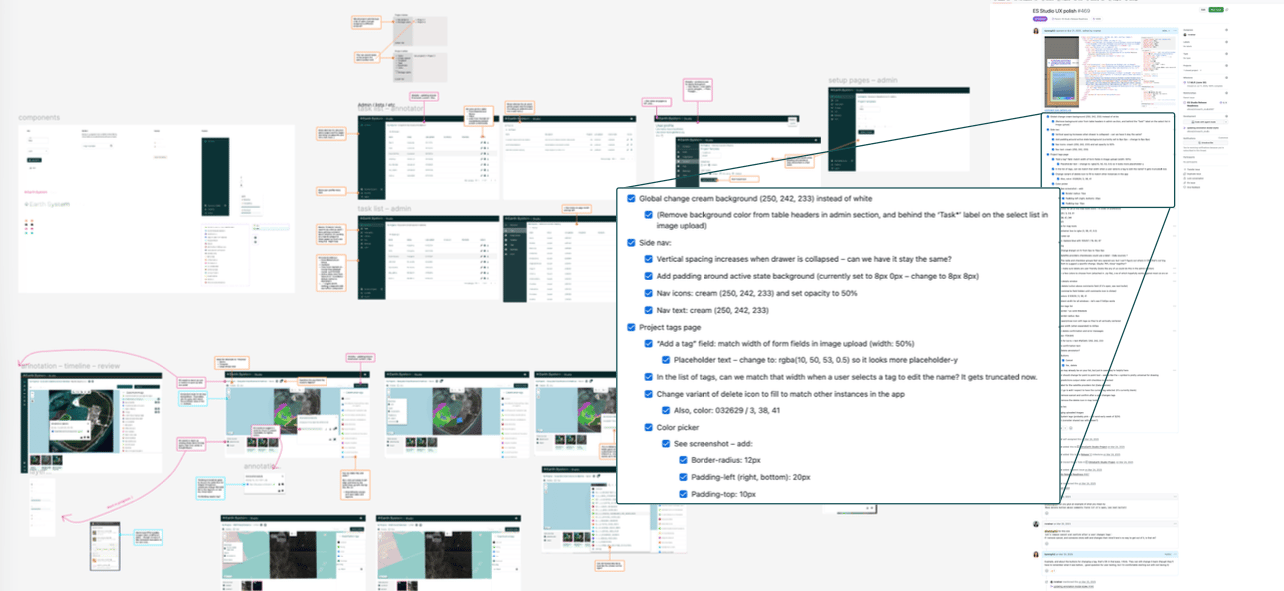
Some stages in the process could get messy
The process
Studio (joined mid-development)When I was brought onto Studio, development was already underway. I adapted quickly, working closely with an engineer I'd collaborated with for years – we've developed a real shorthand that lets us move quickly and iterate in real time. Depending on what the moment called for, that meant marked-up screenshots, GitHub checklists, or high-fidelity Figma components. The shipped code frequently matched the Figma designs closely as a result.
Viewer (0→1)The Viewer was a different story – I was involved from the beginning. I started with landscape analysis and workflow diagrams to understand the space, moved into wireframes to establish structure, and built up to high-fidelity Figma designs through iterative working sessions with the engineering lead. We'd review designs in Figma together, look at the live build side by side, and work through style update lists in real time.
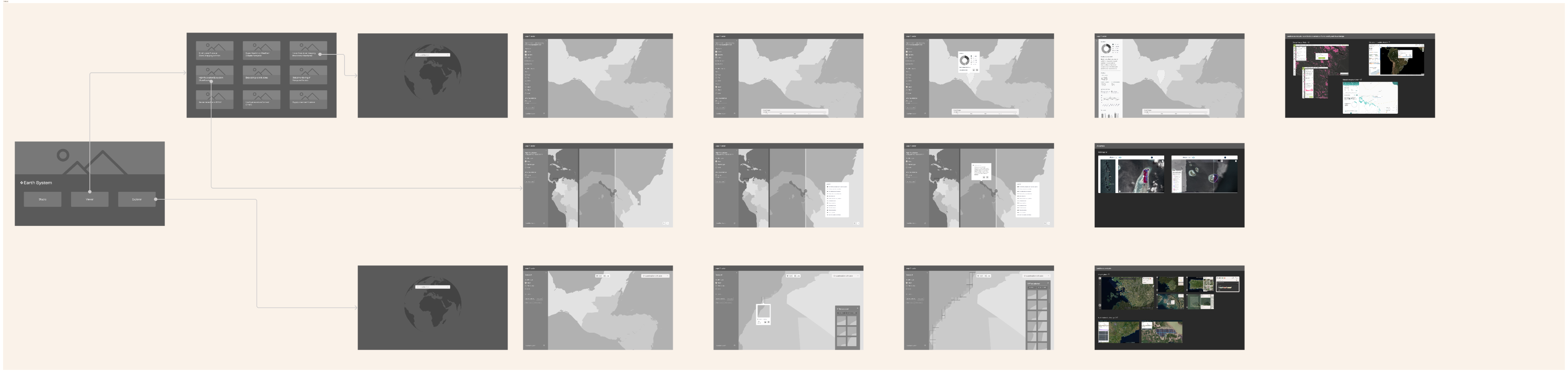
Early stage viewer wireframes
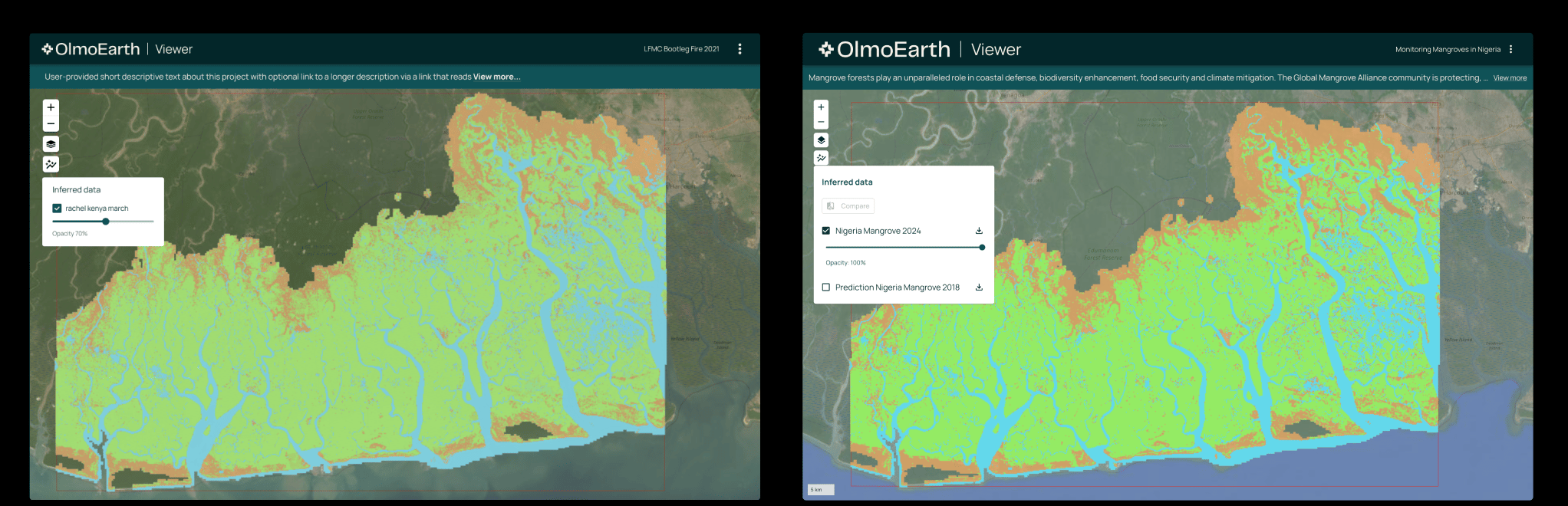
When the handoff just works. Figma comp on the left, live build on the right.
Public-facing propertiesAs Viewer functionality solidified, we turned attention outward – the OlmoEarth landing page, the public projects page, conference booth materials, and the Ai2 marketing page. These required a different design mode: less about workflow, more about communicating the platform's potential to a broader audience.
Research, systems, and staying opportunisticUser research has been woven throughout – working with a researcher to plan and conduct interviews, creating a journey map to identify workflow gaps, and developing personas to build a shared understanding of who we're designing for: primarily conservation organizations and NGOs. A partner workshop in May created an unexpected window to gather direct user feedback; I scrambled to take advantage of it, facilitating feedback sessions on the spot and bringing findings back to the team in a form they could act on. That kind of opportunistic research has shaped a lot of how the platform has evolved. Most recently, temporal UI – a friction point that surfaced from that workshop – has become a primary active design workstream. On the systems side, I've been extending AI2's design system to address OlmoEarth's growing component needs.
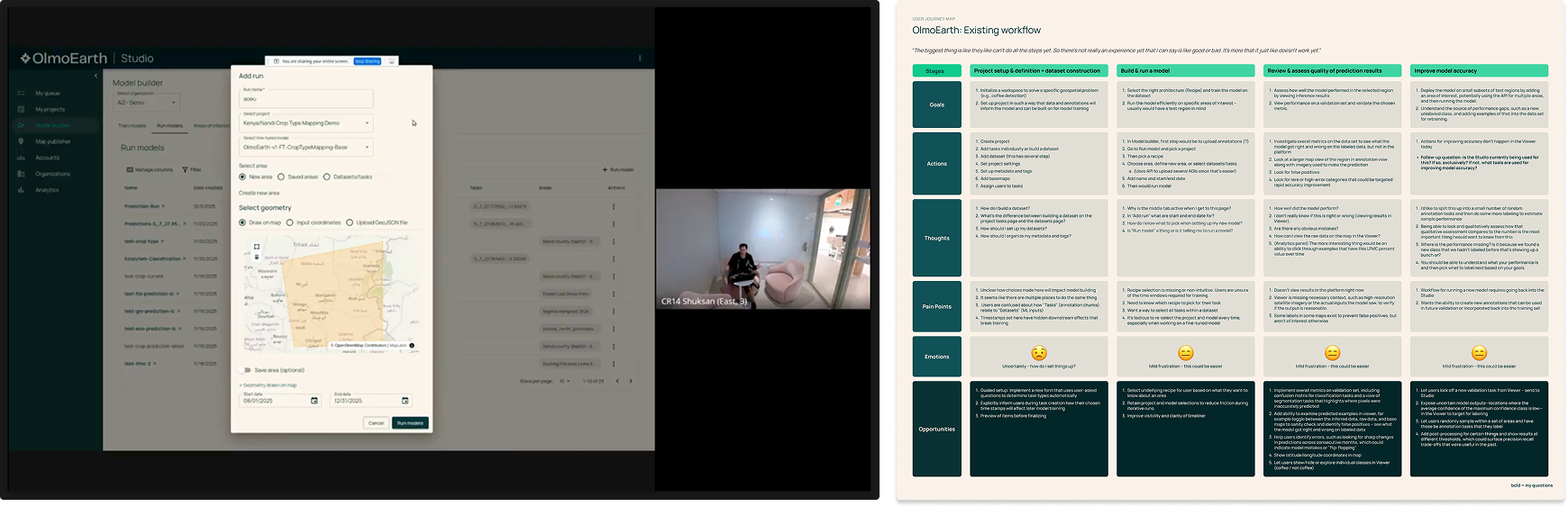
All of our decisions are grounded in user needs.
A few dynamics worth noting
Navigating a distributed stakeholder groupWorking across a large, distributed stakeholder group meant that decisions made in one conversation didn't always align with decisions made in another. Keeping everyone moving in the same direction required staying connected across working groups and knowing when to surface a conflict early rather than let it compound.
Range of fidelity as a tool, not a shortcutWorking at multiple fidelity levels simultaneously wasn't a compromise – it was the right approach for a fast-moving, resource-constrained team. Knowing when to reach for a marked-up screenshot versus a polished Figma mock is a judgment call I make constantly, and getting it right kept momentum without sacrificing quality where it mattered.
Outcomes
The platform launched to significant interest and press coverage:
- FastCompany: Paul Allen's AI nonprofit unveils satellite data platform
- Fortune: Inside the new open AI platform that helps anyone track a changing planet
- GeekWire: Ai2 loosens Big Tech's grip on Earth insights with open-source AI models for climate and conservation
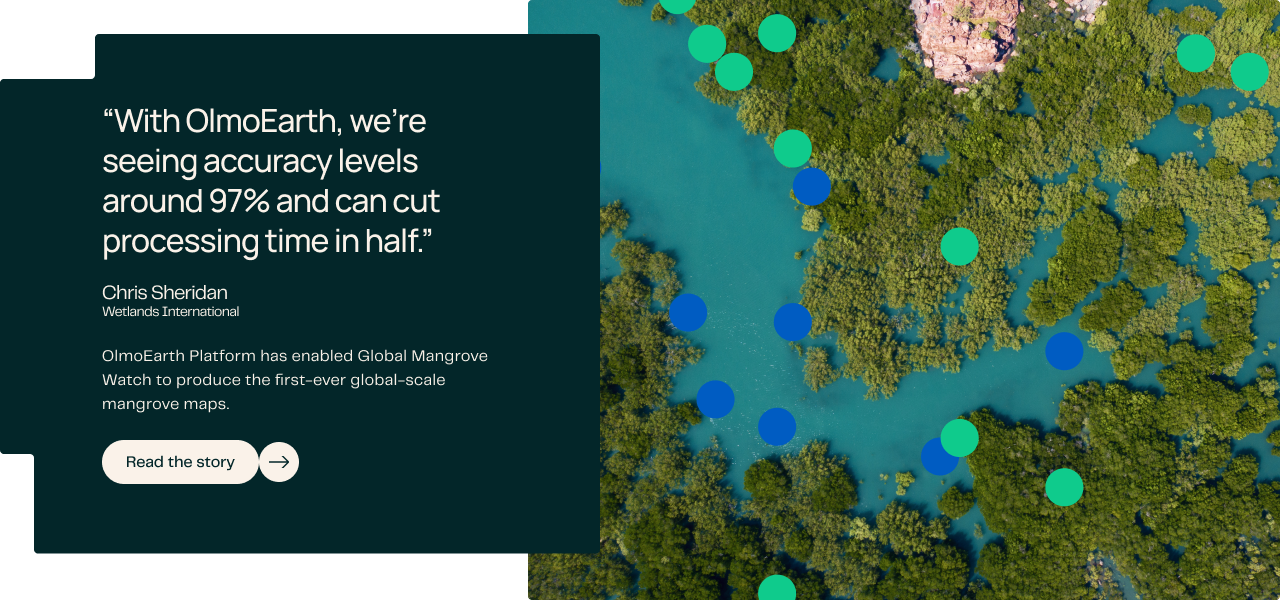
Early partners are already putting it to work: updating global mangrove maps twice as fast with 97% accuracy, detecting deforestation across the Amazon, and mapping vegetation dryness in Oregon for wildfire prediction.
Internally, ML practitioners are actively using the platform and engaged in the iterative improvement process. A partner workshop in May 2026 generated a prioritized list of workflow improvements now actively shaping development.
What’s next
The open question for the platform: will Studio and Viewer eventually merge into a single unified product? As I continue the temporal UI work and broader IA improvements, that's a design challenge we’re actively thinking through. We're leaning hard into the iterative loop: design, ship, learn, refine. Repeat.